BMW M57 BOSCH 10 BAR MAP SENSOR INSTALLATION GUIDE
A practical guide to installing and calibrating a Bosch 10 bar MAP sensor on high-boost BMW M57 applications.
WHAT IS A 10 BAR MAP SENSOR?
The standard MAP sensor used on BMW M57 engines has a limited pressure measurement range. On high-boost applications, the sensor can reach its maximum value, making accurate boost control and data logging impossible.
A 10 bar Bosch MAP sensor allows significantly higher manifold pressure to be measured while maintaining a conventional analogue output within the 0–5 V range.
WHEN IS A 10 BAR SENSOR REQUIRED?
A 10 bar MAP sensor is mainly intended for heavily modified M57 engines running boost levels beyond the range of the standard sensor. It is particularly useful on high-boost and compound turbo setups.
SENSOR
Bosch 10 bar MAP sensor
Bosch part number: 0 261 230 112
Bosch AA Sensors – Sensor Technical Information
SENSOR LOCATION
WHERE SHOULD THE MAP SENSOR BE CONNECTED?
The sensor should measure intake manifold pressure after the intercooler, at a location that accurately represents the pressure seen by the engine.
Bosch 0 261 230 112 was installed in the charge pipe between the intercooler and the intake manifold.
A dedicated sensor flange was welded directly into the aluminium charge pipe and the Bosch sensor was bolted to the flange. This allows the sensor to measure the actual manifold charge pressure after the intercooler, close to the intake manifold.
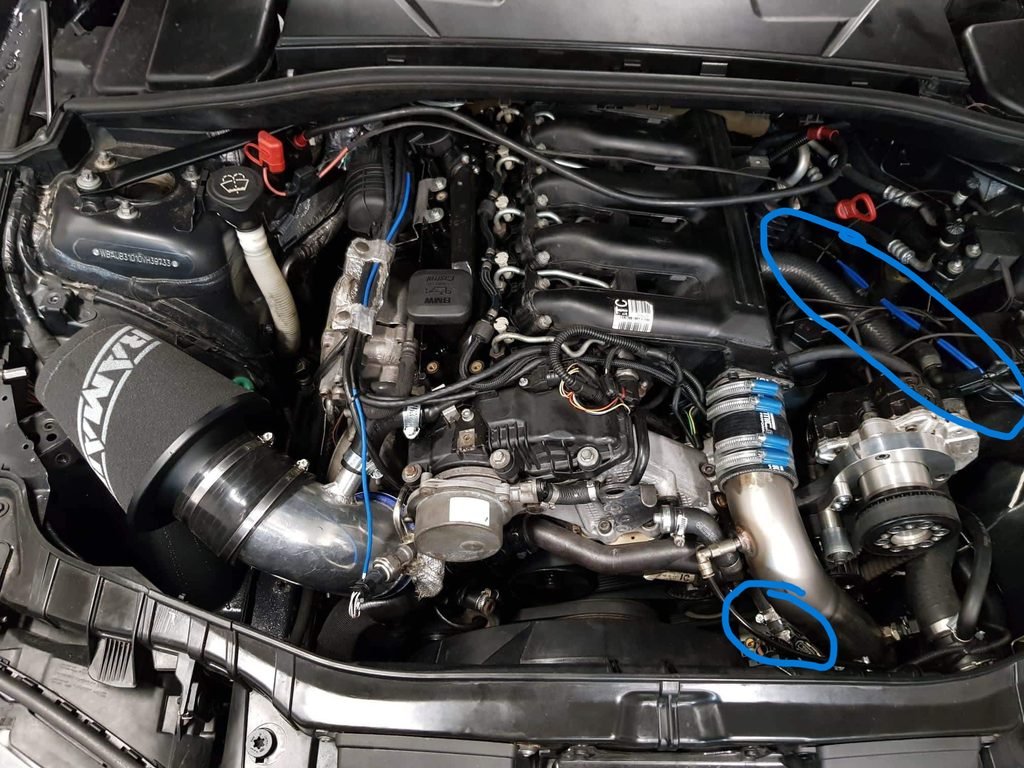
Bosch recommends installing the sensor with the pressure connection facing downwards where possible, helping prevent condensate from collecting inside the pressure cell.
ADAPTER HARNESS
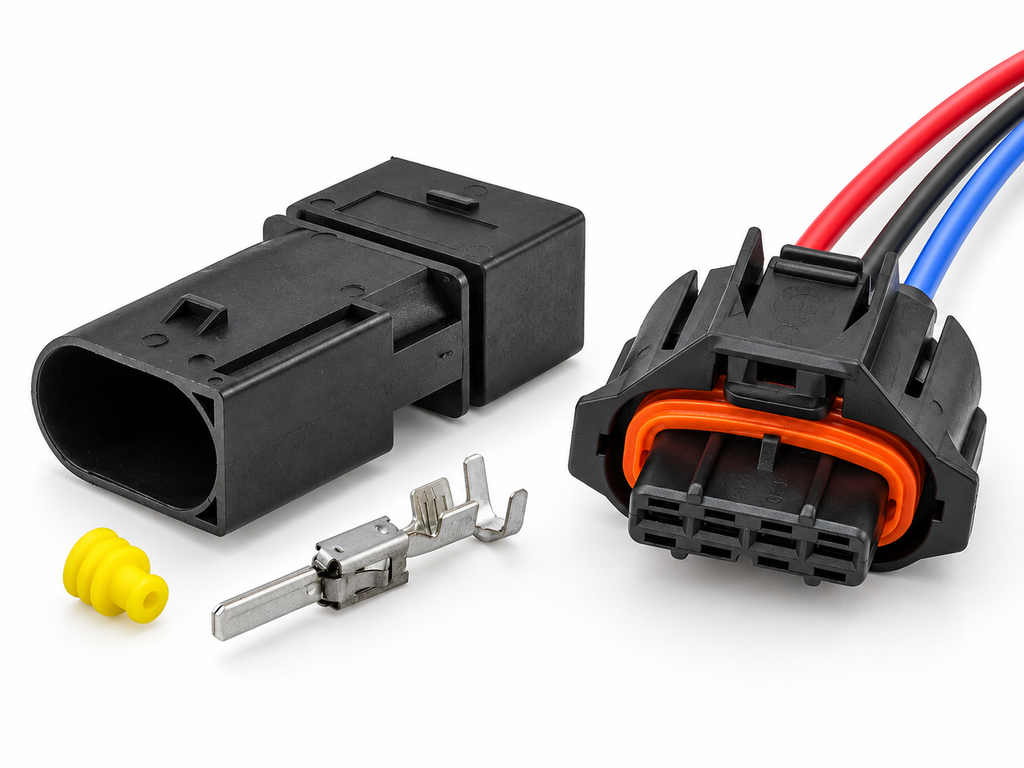
To avoid modifying the original vehicle wiring, a plug-in adapter harness was made.
One side of the adapter connects directly to the original BMW MAP sensor connector using a 3-pin KOSTAL SLK 2.8 male connector. The other side uses a 4-way sealed Bosch connector compatible with the 10 bar MAP sensor (1 928 403 736).
| Original BMW connector | Function | Bosch 0 261 230 112 |
|---|---|---|
| Pin 1 | +5 V supply | Pin 3 |
| Pin 2 | Sensor ground | Pin 1 |
| Pin 3 | MAP signal | Pin 4 |
| — | Temp. sensor | Pin 2 – not used |
Original BMW MAP sensor – X2014
- Pin 1 –
U_LDF– sensor supply – White (WS) - Pin 3 –
A_LDF– pressure signal – Blue/Yellow (BL/GE) - Pin 2 –
M_LDF– sensor ground Brown/Green (BR/GN)
Wire colours are based on the BMW wiring diagram.
Bosch pin 2 is used for the integrated NTC temperature sensor and is not required when the sensor is used only as a replacement MAP pressure sensor.
SENSOR SPECIFICATION
Bosch 0 261 230 112
- Pressure range: 50–1000 kPa absolute
- Equivalent range: 0.5–10.0 bar absolute
- Supply voltage: 5 V nominal
- Output: approx. 0.3–4.8 V
- Response time: 1 ms
- Operating temperature: −40°C to +125°C
ECU CALIBRATION
After installing the 10 bar MAP sensor, the ECU calibration must be updated to match the new sensor characteristic. The Bosch 0 261 230 112 operates over a pressure range of 50–1000 kPa absolute, with an output of approximately 0.3–4.8 V at a 5 V supply. The MAP sensor linearisation in the DDE must therefore be changed so that the ECU converts the sensor voltage into the correct absolute pressure value.
| Sensor voltage | Absolute pressure |
|---|---|
| 0.30 V | 0.5 bar |
| 4.80 V | 10.0 bar |
The DDE linearisation should be configured using these two nominal characteristic points for the Bosch 0 261 230 112 sensor.
ABSOLUTE VS BOOST PRESSURE
MAP sensors normally measure absolute pressure, not gauge boost pressure.
Boost pressure = Absolute manifold pressure − Atmospheric pressure
4.0 bar absolute ≈ 3.0 bar boost at approximately 1.0 bar atmospheric pressure.
BEFORE STARTING THE ENGINE
Before driving the vehicle, check the MAP reading with the engine off. It should be close to the current atmospheric pressure.
CHECKLIST:
- Verify 5 V supply
- Verify sensor ground
- Check signal voltage
- Confirm atmospheric pressure reading
- Confirm ECU sensor scaling
- Check for pressure leaks
- Log MAP pressure during the first test
FINAL NOTES
A correctly installed and calibrated 10 bar MAP sensor allows accurate boost measurement on high-power BMW M57 applications where the standard sensor range is no longer sufficient.
The mechanical installation, wiring and ECU calibration must all match the sensor specification.
DISCLAIMER
This information is intended as a technical reference for experienced users. Incorrect wiring or ECU calibration can cause incorrect pressure readings, boost control problems or damage to vehicle components.