
A practical guide explaining when upgraded valve springs are actually required on modified BMW M57 and N57 engines and why boost pressure alone does not tell the whole story.
1. WHY UPGRADE VALVE SPRINGS?
As boost and exhaust manifold pressure increase, the forces acting on the valves also increase. At some point, the standard valve springs may no longer provide enough force to maintain reliable valve control.
This can lead to valve float, reducing the engine’s volumetric efficiency (VE) and directly affecting airflow, cylinder filling and overall performance.
2. BOOST PRESSURE ALONE IS NOT ENOUGH
Turbocharger efficiency, EMP, engine speed, and intended use should all be considered. VNT control strategy also has a major influence on EMP, as excessive vane closure can significantly increase exhaust manifold pressure, especially at higher engine speeds.
With correct turbocharger control and ECU calibration, excessive EMP can often be reduced, which may help decrease the risk of valve float. This is especially important on VNT turbochargers, where excessive vane closure can significantly increase exhaust manifold pressure.
However, calibration cannot compensate for insufficient valve spring force in every situation. On high-boost or high-EMP setups, upgraded valve springs may still be required.
High exhaust manifold pressure increases the force acting against the exhaust valve. This is why EMP is often more useful than boost pressure alone when deciding whether stronger valve springs are required.
Monitoring EMP is extremely useful when optimising VNT control and evaluating valve load.
Read the guide: How to Install an Exhaust Manifold Pressure (EMP) Sensor on BMW M57 → https://revload.net/knowledge-base/bmw-m57-exhaust-manifold-pressure-emp-sensor-installation/
3. WHEN STOCK SPRINGS MAY STILL BE ENOUGH
- Moderate boost with controlled EMP
- Efficient turbocharger setup
- Significant power reduction at higher RPM
- Reduced engine speed range
A well-balanced setup with moderate EMP may still operate correctly on standard valve springs, even at relatively high boost pressure. However, the mileage and age of the engine should also be considered, as older springs may provide less spring force and therefore less safety margin in a modified engine.
For Stage 3 setups, replacing the original valve springs is generally recommended. At minimum, the engine should be fitted with new OEM springs. For higher boost, higher EMP or more aggressive setups, upgraded valve springs are the preferred option.
4. WHEN UPGRADED SPRINGS MAKE SENSE
- high EMP
- high boost combined with restrictive turbine side
- extended high-RPM operation
- compound turbo setups
- competition / drag use
- WMI / very high cylinder filling
- increasing power significantly beyond the original engine operating range
5. CASE STUDY – HOW EMP AND VNT AFFECT VALVE CONTROL
The log below comes from a 500+ HP BMW M57 equipped with a Turbosystems Stage 3 hybrid turbocharger. From my experience, this is one of the most efficient M57 hybrid turbochargers available in terms of airflow, response and EMP control at this power level.
This is important when interpreting the data. A less efficient or more restrictive hybrid turbocharger may produce a significantly worse EMP-to-boost ratio at the same boost pressure and engine speed, increasing exhaust valve load and therefore increasing the risk of valve float.
If EMP is already increasing significantly with an efficient Stage 3 hybrid, the same power target with a more restrictive turbocharger can place considerably more load on the exhaust valves.
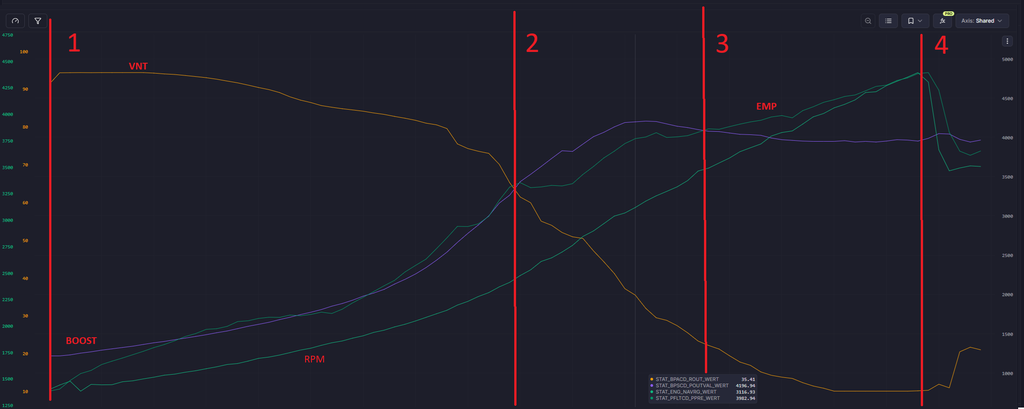
Boost pressure, exhaust manifold pressure (EMP), VNT control and engine speed are logged together to show how turbocharger behaviour changes throughout the RPM range.
1-2: TURBO SPOOL
At low engine speed, the VNT is heavily actuated to generate turbine drive and bring the turbocharger onto boost. Both boost and EMP increase as engine speed rises. High VNT demand during this area is normal, as the priority is turbocharger response and spool.
2-3: BOOST BUILD / TRANSITION
As the turbocharger reaches the required boost pressure, VNT demand is progressively reduced. Boost continues to increase while EMP remains relatively well controlled. This is the area where an efficient turbocharger can deliver the required airflow without excessive exhaust back pressure.
3-4: HIGH-RPM OPERATION
At higher engine speed, boost pressure remains relatively stable while EMP starts to increase significantly. At the same time, the VNT command is already close to its minimum value. This indicates that the turbine side is becoming increasingly restrictive as exhaust mass flow rises
This operating area places significantly more load on the exhaust valves. If the valve springs are already weakened or insufficient for the application, the increased pressure differential can contribute to poor valve control and valve float, reducing volumetric efficiency and engine performance.
Further VNT adjustment may help reduce EMP on some setups, but once the turbocharger is already operating near its maximum flow capability, calibration alone cannot remove the mechanical restriction.
This log demonstrates why boost pressure alone is not enough to determine whether upgraded valve springs are required. At the same boost pressure, EMP can vary significantly depending on engine speed, turbocharger efficiency and VNT control.
The high-RPM section is particularly important: boost remains nearly constant while EMP continues to rise, increasing the force acting on the exhaust valves.
6. VALVE SPRING SELECTION GUIDE
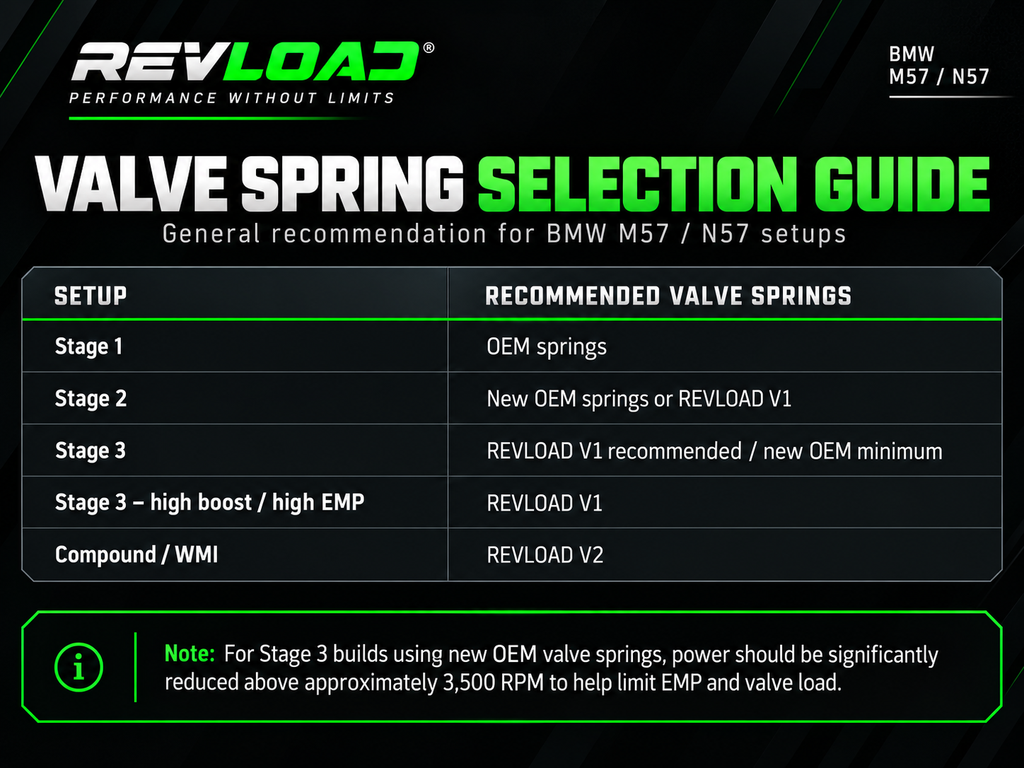
This table should be treated as a general guideline only. Boost pressure, EMP, turbocharger efficiency, RPM range and engine mileage should always be considered when selecting valve springs.
7. PERFORMANCE VALVE SPRINGS AVAILABLE FROM REVLOAD
REVLOAD performance valve springs are available for both BMW M57 and N57 applications. Different spring specifications are offered depending on the required level of valve control, boost pressure, EMP and intended use.
- BMW M57 V1 / V2
- BMW N57 V1
DISCLAIMER
This guide is intended as a general technical reference. Valve spring requirements depend on the complete engine and turbocharger setup, including boost, EMP, RPM range, engine condition and calibration. Incorrect setup or component selection can result in reduced performance or engine damage.